Me Encanta
The Love of God

*10 years ago today, I published my first book: Finding God in the Ruins (How God Redeems Pain). It hardly seems possible. To honor the day, I’m sharing my favorite chapter from that book. To me, it’s remains one of the most meaningful things I’ve ever written. My sister Trina was still alive when the book released. Eight months later, she was gone. This is about the journey before she left us.
When I was a kid, my favorite substitute teacher shaved a full beard. She wore big gold brooches on the lapel of her pantsuits. She looked just like Gabe Kaplan from Welcome Back, Kotter and sang bass in a female choir called Sweet Adelines. She was the most unexpected thing we had ever seen—as manly as our dads but as tender as our grandmothers. With all that was happening in my adolescent years, I needed to know I was worth something. Mrs. Banning made it clear that I was. I loved her and knew that she loved me. I imagine God is pleased when we allow the foolish things of this world to confound our wisdom—when we allow ourselves to be drawn into his love in the most peculiar ways. I won’t forget Mrs. Banning, and I won’t forget her brooches either—big golden bees and hummingbirds, so feminine on such a masculine woman. It was odd. She was odd. As odd as God.When I was a junior at Anderson University, my Spanish professor, Dr. Sid Guillen, had a stroke right there in the classroom. He was lecturing on verb conjugation when I noticed he had conjugated a verb in the wrong tense. Because Spanish was Dr. Guillen’s native tongue, this woke a few of us out of our higher-learning hypnosis. I looked up and saw a troubled look on his face.
“Mr. Guillen, are you okay?” I asked as he fell to his knees. Within seconds another student ran out of the classroom to call 911. By the time the ambulance arrived, several of us were gathered around him, stroking his hair and telling him everything was going to be okay. There were tear streaks like toboggan chutes down each side of his face, and fear was deeply set in his eyes as he mumbled gibberish to us in Spanish. Initially he tried coming back to class but suffered another stroke and had to call it quits for good.
It was odd not seeing Dr. Guillen in class. He was replaced by a man who was a complete snooze, and we missed Dr. Guillen terribly because he was full of surprises, kicking over desks when we weren’t paying attention and breaking into loud Spanish love songs without warning. A couple of years ago, I read in our alumni newsletter that Dr. Guillen had passed away. The article said he had lived a long life and was surrounded by family when he died.
You get to thinking about the impression people leave on you after they die. Dr. Guillen once told us we should be taking his Spanish class very seriously even if it was only a core class. Why?
“Because Spanish is what they speak in heaven,” he told us, “and you’re going to want to be able to say more than just ‘¿Cómo te llamas?’ to the Almighty when you get there.” And he was right. Only being able to ask God his name might not be terribly impressive. So I listened to his advice and dug into my Spanish homework. I’m pleased to say that after taking two years of high school Spanish followed by one year in college, I’d be able to ask God not only his name but also for directions to the bathroom. And I could easily tell him I liked his dog. “¡Me gusta tu perro, Jesús!” So I think I’m in good shape.
This morning I watched a YouTube video that brought tears to my eyes. I’ve seen it before, but for some reason the music, the man’s voice singing, and the pairing of the song with Pachelbel’s Canon went straight through me. There are heavenly moments when everything comes into order and you have no trouble believing there is more out there. I had one of these moments the other day on a bike ride.
I rode into the little town of Westfield, Indiana, and then farther out into the country. Rows of corn lined the asphalt road as my tires buzzed against it. Sometimes I talk to the corn while I ride. “Hello, corn. You’re beautiful this year,” I say. It’s odd, I’ll admit, but I think it can hear me even though it never says a word.
I parked my bike on the side of the road and examined the way the corn shot out of the ground and how the leafy husk wrapped itself so tightly around the cob, protecting the kernels inside, and as I stood admiring each long regal limb, I had my moment. I felt God walking out to me from deep within the rows of corn. He almost never speaks to me anymore, but I don’t worry about that at all. I used to beg him to tell me stuff—to answer my questions and tell me why for so many things I didn’t understand, things I had decided to make him responsible for. But on this day, he stood quietly at my side as we admired the corn together.
“Hmm,” I said. “Just beautiful.”
“Yeah,” he said back.
And in this fraction of a moment, my spirit didn’t have to figure anything out—didn’t have to know why for a thing. I carry moments like this with me. I have so many of them locked away in a special jar.
Another one of them was at the visitation for my brother’s funeral. The room was filled with guests and stories were flying everywhere. It felt so much more like a family reunion than a funeral. And then it happened: I heard my mom.
A cry cut through the place and brought the room to a deafening silence. Several hundred of us stood by listening to the grieving howl as a mother’s soul replaced the beautiful memory of her son’s birth with his death. It was a song that until this day I had never heard. Her own death rang out among the living, killing us softly. And in her grief, I could hear God singing—singing of human collapse, of heartbreak and tragedy, where he is so easily found yet so casually dismissed. I didn’t like his song one bit, but I heard it just the same and would have been a fool to pretend he wasn’t strumming my pain with his fingers.
I’ve had the thought for quite some time of what it would be like to hear God sing. It was such a beautiful thought to me because I am a musician by trade. I imagined all the lovely voices I’d ever heard: the power of dramatic classical sopranos, the guts of black gospel singers, and the passionately organic voice of such singers as Annie Lennox all rolled into one. I could imagine the potential. I could visualize God’s singing voice overwhelming all who heard it.
One day I picked up a CD in a music store and as I read through the song titles on the back cover, I saw “Imagine (How God Can Sing).” It was the very last song on the CD. I didn’t hesitate. I purchased the CD immediately for that song title alone. Someone had finally done it—captured the idea of what it would be like to hear God sing. In it, I thought there might be a clue, some kind of insight into the God of the whole universe. And because I wanted to be in the know, I raced back to my office to give it a listen.
Sitting in my chair near the window that looked out over the parking lot, I peeled back the cellophane and popped the shiny new disc into the kind of machine you see only at garage sales anymore. I was expectant. It was the last track. Some of the best songs I’ve ever heard were last tracks. I thought about the last track on Cindy Morgan’s Listen project and remembered how it haunted me the first time I heard it. I quickly forwarded the CD to track eleven. The song began and I sat quietly, staring out the window, hanging on every note and word.
I tried hard to take it in—the lyrics and the melody—but the song didn’t pan out for me as I’d hoped it would. I expected a revelation but was left ambivalent. I felt cheated. Surely the songwriter must have known that a song about God singing needed to be something special—a whale call, forty-three harps being plucked at the same time, a helicopter blade chopping in the background. Needless to say, it wasn’t inspiring. It was cliché. It happens. It might have overwhelmed someone else, but it didn’t overwhelm me. I set the CD aside, complained to a couple of friends, and got over it.
The longer I live, the more I long for the clues and insights of life (or of God), yet I realize there are so many more things left unexplained than I ever thought there were in my twenties. In my twenties, God was obedient. In my thirties, he was an unruly child, whom I did my best to train up. And now in my forties, he is God and I am not. And his song is minor. There are short-lived moments when he sings in C major, but most often he sings outside the lines, adagio, because of the great skill and lyricism it requires to place each syllable dissonantly within the minor chords. His song is potent, not pretty. And it’s only beautiful sometimes. It is anything but cliché.
I have felt peculiar in my forties, as though there is a crack in my heart. And the more time I spend with good spiritual people (you know the kind: biblically buttoned up, scripture verses on their coffee mugs), the more peculiar my heart, and the more I feel misshapen and out of place. I feel uncomfortable with those eager to punctuate their pain with an exclamation point before it’s time. Instead my heart feels most at home with those who understand their pain and are comfortable putting an ellipsis where an ellipsis belongs, because so many things are left unredeemed.
My sister and Chuck came for a visit this past weekend. As soon as she climbed out of their truck, I could see the effects of the chemo. Her body was not her body. She had gained quite a bit of weight from the steroids, and her face was no longer the shape of my father’s face, as it always had been. It was swollen and odd. A friend of mine who was a nurse told me not to look at Trina with “the death stare,” so I decided that if I needed a moment to gather myself throughout the weekend, I would escape to my closet or go sit in the backseat of my car, both of which I ended up doing several times.
This morning, as Trina was getting ready to leave, I sat on the toilet in our guest bathroom and watched her put on her makeup just as I had when I was a little boy.
“What’s that stuff?” I asked her.
“Brightener,” she told me. “It gets rid of any darkness under my eyes.”
“You’re so pretty,” I told her. She smiled.
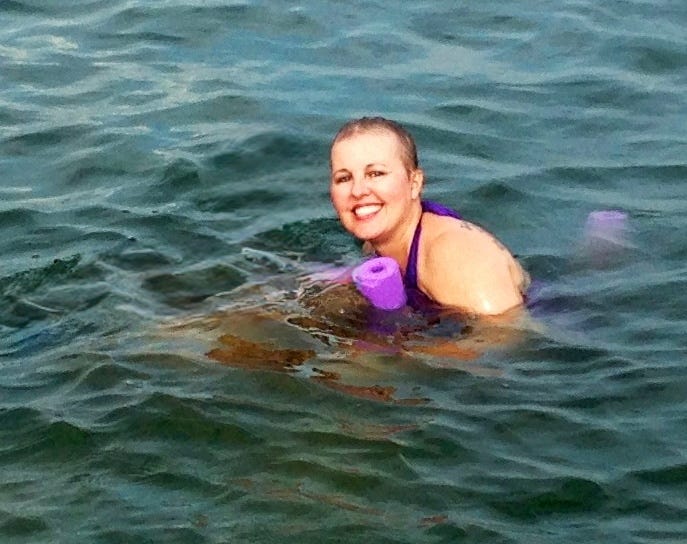
She pulled out eyebrow pencils and focused intently to make sure she got her brows just right in the absence of her own. She had shaved her hair off several weeks earlier because it was getting patchy, but it had since grown about an inch or so. It was the softest hair I had ever felt, although it had almost no color to it at all. I called her Baby Hair several times over the weekend and kissed the top of her head as if she really were a baby. She would smile and giggle at her new nickname.
I had a group of friends gather while she was in town to pray for Trina’s healing. We collected our love and prayers around her and as we prayed, tears streamed down her face and ours.
Afterward, while everyone waited their turn to talk to her, I overheard her tell a friend of mine that not having hair was great for riding on the back of Chuck’s motorcycle because she didn’t have to worry about how she looked when she took off her helmet. It was what I had always loved about her: her ability to believe the best in any situation. And even with the room littered with cancer, threatening her life, showing itself in her warped body, swollen face, and hair loss, her sense of hope hadn’t changed one bit. She put on her makeup just as she always had, as if she were just as gorgeous as she had always been. These things—these incredible things—I pick them up and put them in my jar.
I watched her like a hawk the entire weekend, taking in all the beauty that she is, not able to think of one thing I hadn’t liked about her before. I saw her eat a bowl of vanilla ice cream heaped with Banana Split Oreos she had crumbled on top. She “mmmm’ed” over each bite as if God had pulled the recipe straight from his own stash of cooking magazines. “Hit me again,” she said when her bowl was nearly empty, and I did.
I realized over the weekend that I might know her better than anyone ever has. We had come up in the same family, drawn together as survivalists in the war zone. And as survivors often do, we had formed a bond that would never be broken. I was the first one she called after she made the painful decision to leave her husband of twenty-nine years. On the phone that day, I asked her if she was leaving before she ever mentioned it herself, because I could already hear it in her voice. Because I know her.
We talk on the phone four or five times every week, talking about nothing because we don’t need anything to talk about. We make our way in the conversation without material because enough has already happened. She is not replaceable as my sister. The thought of losing her is absurd.
I am writing this too early to know what will happen to her. And if she passes, I don’t know what will happen to me. It is impossible to gauge whether I will completely fall apart or discover some kind of new strength, which I don’t want if it only means losing her. As far as God is concerned, I have gone down this road before. I have lashed out, unbelieved in him, accused him, and sworn to back out of any deal I’d made with him. But in the end, I have found him capable of restoring my faith because he knows me better than I even know my sister. He’s shown up, amid the visceral pain, in powerful ways I could not excuse, leaving me fully aware that he’d been there. I can’t possibly begin to know that I will always believe him, love him, forgive him, let him in, but so far, in the midst of the most difficult personal circumstances, he has not left me.
He hasn’t answered all of my questions, and he certainly hasn’t “worked all things out for the good” in any way I would’ve expected. But once when I was at an all-time low, he entered into my broken world so unexpectedly and in a way that was so tangible even my peculiar heart couldn’t deny his presence. This heavenly encounter and the personal gift he arrived with will forever remain in my jar.
And still there have been other times when he showed up with only a quiet whisper into my spirit yet fully revived these dried-up bones. He used foolish things like cornfields and bike rides, like my wife and her witty sense of humor that can clear my sorrow away like a leaf blower. Things like my two girls, one whose faith in people I’ve come to depend on, always making a way for even the worst of all pirates, including me. And the other who has her mother’s sense of humor and can manage to make me laugh until tears fill my eyes, completely blurring out my troubles. In these moments, all is well. I feel loved by something. And more than that, I feel comforted, empathized with. I wish I could hold on to this all the time, but it comes and goes and then comes again, sometimes just after I have escaped into my closet or the backseat of my car.
Sometimes it feels as if God has invited himself into my pain, when I had hoped to be invited into his healing. We want a God who heals our wounds, but it seems we have a God who heals our hearts. My expectation was that he would make the pain leave me—that if the pain were little birds nesting in my heart, he would know when it was time for them to go and he’d toss them out of me. But some of them never fly away.
It’s not okay. These birds weren’t meant to nest in me; they were supposed to soar right on past me, beating their wings until I couldn’t see the threat of them anymore. But their wings were clipped, and for reasons I don’t understand, they wound up in my heart. As I said, it’s not okay. It will never be okay. But there they are, just the same. And I have felt that if God were truly God, he would shoo them away or starve them off until they died one by one. But for those things that have been left unredeemed, pain can be a lifetime mortgage. I will pay on it, and I can learn to manage it, but it’s not going anywhere. Yet it will not be all that is me. It does not complete me. While it remains, God also will remain. And I will find him in the ruins, among three thorns and three prayers for their removal. He will provide his compathy and care with cornfields and bike rides and laughter and love—especially love.
If my sister doesn’t survive her fight with cancer, I will be wrecked, and I won’t pretend I shouldn’t be. I will tell God what a liar he is and shake my fist at him for all the bad things that happen. I will tell others he’s a fraud and that he kills the people other people need. I will walk my cul-de-sac in protest. I may even abandon him.
But then I imagine he will do what he always does. In some unexpected way, he will show up—show up for me, and in your pain, show up for you. And together we’ll find him. We will find God in the ruins.
After watching the YouTube video that so moved me this morning, I looked down to see the remarks others had written about it. There were several, but my eyes focused on one: “Me encanta.” It was one of the few Spanish phrases I could still recall from Dr. Guillen’s class. Someone had watched the same video, and I imagine had a moment for which they had written only two words: “Me encanta.”
I love.
Those things left unredeemed in us are unfinished stories we’re desperate to punctuate, hoping to turn the page and see “The End.” But tragedy will always be with us, as will disbelief, fear, abandonment, and the abysmal injustices we see every time we turn on the television. At times the adversity and pain of this world have siphoned off whatever belief was left in me. But then I go to my jar, and I remember the corn in Westfield, how its long regal limbs pressed themselves up toward the heavens. Or I conjure up the image of my dearly beloved sister, riddled with cancer from head to toe, talking about the benefits of not having hair as if even the storm cloud that is cancer has a silver lining. Or I close my eyes and hear the terribly holy song I heard God singing in my mother’s grieving howl at my brother’s funeral, and I don’t hear unbelief at all or even death. Instead I hear two words: “Me encanta.” I don’t know why I hear them, but I know I can’t shake them. And truth be told, I don’t want to. They are imprinted into the spiritual DNA of who I am, and they speak to my tragedies, my doubts, and my personal failures.
Time and time again, I hear them called out to me in the tiniest voice—a voice so small it could fit only within the most peculiar crack of my heart.
Me encanta. Me encanta. Me encanta.
I love.
*Here’s the book trailer to this book. I’m so grateful I made this happen. It’s something I’ll always cherish. She’s gone now, but that day was just so beautiful. This is the original book trailer for my first book: Finding God in the Ruins (How God Redeems Pain). Happy 10-year anniversary to this book.